

Why Compounded Eye Drops Have Short Beyond-Use Dates
Understanding USP <797> BUD Standards for Sterile Medications
At Massey Drugs, we are often asked why compounded eye drops carry significantly shorter beyond-use dates (BUDs) than commercially manufactured products’ expiration dates. While these dates may seem conservative, they are not arbitrary because they are determined by United States Pharmacopoeia (USP) standards to which 503A compounding pharmacies must adhere.
What is a Beyond Use Date?
A BUD is the maximum time a compounded sterile preparation (CSP) can be stored before it must be discarded. This date is based on when the medication is compounded — not when it is dispensed — and ensures the product remains sterile, stable, and safe for use. According to United States Pharmacopeia (USP), “BUDs are intended to minimize the risk of microbial growth in the event of inadvertent contamination, and to allow for patient access to critical therapies.”
The BUD is not the same as an expiration date on commercially approved medications. It reflects conditions specific to the compounding process, the compounding environment, and the ingredients used.
What determines a BUD?
USP <797> – a national standard enforced by state boards of pharmacy – requires that BUDs must be assigned based on:
- Sterility risks: Including how and where the drug was compounded
- Starting ingredients: Whether sterile or non-sterile
- Container compatibility and integrity: Such as dropper bottles
- Storage conditions: Room temperature (RT), refrigerated, or frozen
- Batch testing: BUDs are shorter without sterility testing
- Sterilization method: Whether by:
1. Filtration
• Solution is filtered then containers are filled using aseptic technique
• Most common method in ophthalmic compounding
2. Terminal sterilization (in the final sealed container)
• Allows for longer BUDs but involves either
→ Heat – will melt droptainers
→ Irradiation
• often incompatible with the formulation
• adds time and cost before dispensing
• batches must must be sterilized by a third party
Compounding Categories and What They Mean
Massey Drugs is a Category 3 sterile compounding pharmacy — the highest level defined under USP <797>. This classification reflects the most advanced facility and operational standards in sterile compounding, including:
- Sterile garb and no exposed skin in the cleanroom
- Rigorous cleaning/disinfection, environmental monitoring, and aseptic technique validation
- Routine sterility and endotoxin testing on applicable batches
- Additional formula testing including stability, antimicrobial effectiveness, particulate matter, and container integrity
- Robust quality assurance and documentation practices
These standards allow us to assign extended beyond-use dates (BUDs) — longer than those allowed under Category 1 or 2 — but only when we complete all required formula/batch testing and maintain strict compliance with USP <797>.
Category 3 Maximum BUDs (with Required Formulation and Batch Testing)

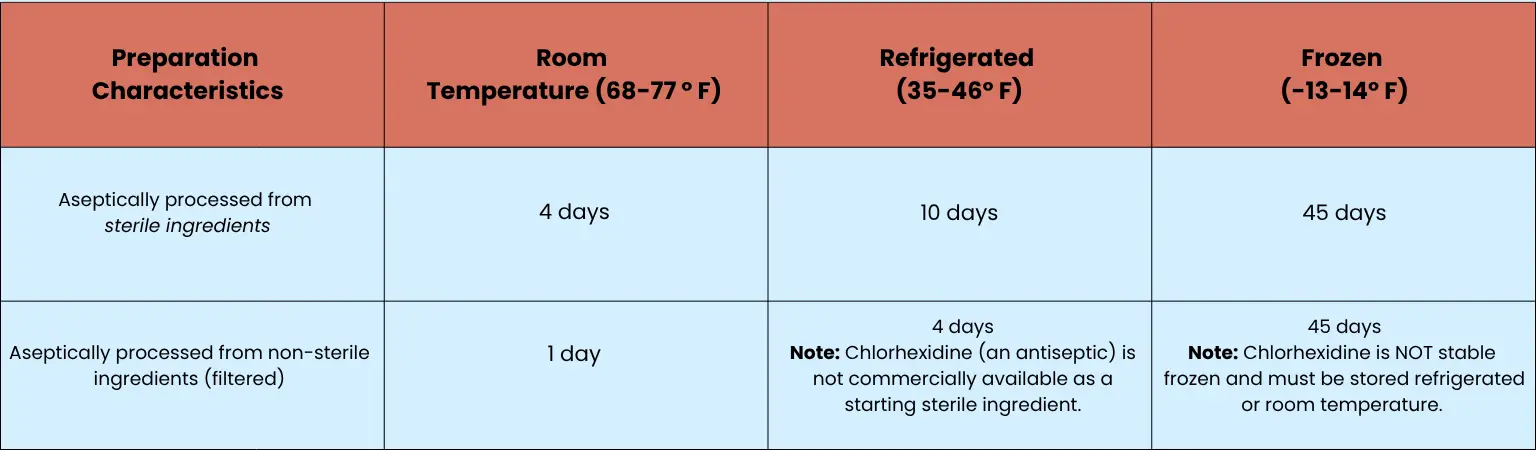
Category 2 Default BUDs (without Batch Testing)
Why It Matters
Eye drops are applied directly to sensitive tissue and must remain stable and free of microbial contamination. Even a small breach in sterility could lead to serious infections or vision loss. Assigning a shorter BUD is part of protecting patient safety.
We understand that some providers are accustomed to longer dating on commercially manufactured products. However, compounded medications must adhere to a different regulatory framework — one designed to prioritize safety in small-batch, patient-specific formulations.
Key Takeaways
- BUDs are assigned based on USP <797> standards — not pharmacy preference. Even if a room temperature formulation has been successfully tested for 365 days, USP limits the BUD to 60 days room temperature.
- Category 3 pharmacies like Massey Drugs operate under stricter cleanroom standards
- Without batch sterility testing, maximum BUDs (RT–refrigerated–frozen) are:
- 4–10–45 days for sterile starting ingredients or
- 1–4–45 days for nonsterile starting ingredients
- According to USP, BUDs are primarily based on factors that could potentially affect sterility. Pharmacies may perform analytical testing to demonstrate longer dating, however the BUDs may not supersede current <797> standards.
If you have questions about BUD assignment or compounded ophthalmic storage, contact us or call 833.540.3500 to speak with a pharmacist.