

Testosterone Therapy and Female Libido: What New Research Reveals About Treatment Outcomes
A 2026 study examining testosterone injections, topical formulations, and pellets provides new insights into sexual desire outcomes among women receiving testosterone therapy.
Testosterone plays an important role in female sexual health, particularly sexual desire and arousal. Research has demonstrated that testosterone therapy can improve sexual function in appropriately selected postmenopausal women diagnosed with hypoactive sexual desire disorder (HSDD).
A study published in the May 2026 issue of the Journal of Urology examined patient-reported outcomes among women receiving testosterone through three delivery methods: injections, topical formulations, and subcutaneous pellets.
Key Research Findings at a Glance
- 87% reported improved libido: In a 2026 retrospective study involving 119 women receiving testosterone therapy, 87% reported improvement in sexual desire.
- Injectable testosterone showed encouraging results: Reported libido improvement was 100% with injections, compared with 90% for pellets and 82% for topical formulations. However, the injectable group included approximately 19 women, and the study did not establish that injections were superior.
- Broader research supports testosterone for HSDD: A 2019 meta-analysis of 36 randomized controlled trials involving 8,480 women found improvements in sexual desire, arousal, orgasmic function, and sexually related distress.
- Sexual satisfaction also improved: The meta-analysis found approximately one additional satisfying sexual event per month among women receiving testosterone compared with control groups.
- Individualized treatment remains essential: Appropriate patient selection, hormone monitoring, and evaluation of potential adverse effects are important considerations during testosterone therapy.
New Research Examines Testosterone Delivery Methods and Libido
The 2026 Journal of Urology study retrospectively evaluated 119 women who received testosterone therapy between 2009 and 2025. Participants had an average age of 64 years and an average follow-up of 4.9 years.
Researchers compared outcomes among women receiving injectable testosterone, topical formulations, and subcutaneous pellets.
Reported Libido Improvement by Delivery Method
2026 retrospective study | 119 women | Average follow-up: 4.9 years
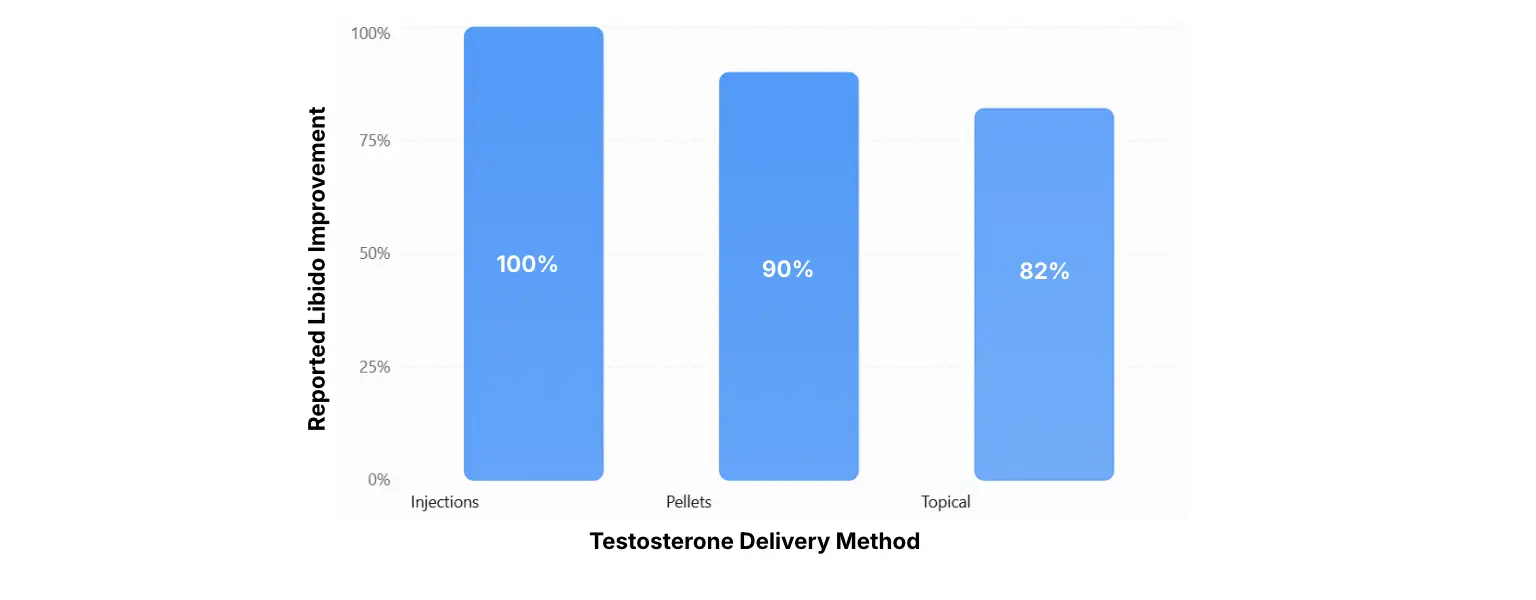
Source: Journal of Urology, May 2026, abstract IP22-30. Approximately 19 participants received injections. Observational findings do not demonstrate that one delivery method is superior.
The researchers reported a statistically significant difference in libido improvement across treatment groups (p = 0.02).
Although the injectable group reported favorable outcomes, the study was retrospective, nonrandomized, and relatively small. These findings do not establish that injections are more effective than other delivery methods.
The researchers also reported increased free testosterone concentrations across all three groups. Acne and increased facial hair growth were among the reported adverse effects, reinforcing the importance of clinical monitoring.
Study: Long-Term Testosterone Replacement in Females — Journal of Urology, May 2026
What Does Broader Research Tell Us About Testosterone and Female Libido?
The potential benefits of testosterone therapy for female sexual function have been examined in numerous clinical trials.
A comprehensive 2019 systematic review and meta-analysis published in The Lancet Diabetes & Endocrinology evaluated 36 randomized controlled trials involving 8,480 women.
Researchers found that testosterone therapy improved several aspects of sexual function in postmenopausal women, including sexual desire, arousal, orgasmic function, and sexually related distress.
The analysis also found approximately one additional satisfying sexual event per month compared with placebo or comparator treatment.
These findings provide substantial evidence supporting testosterone therapy for appropriately selected women with HSDD. However, the strongest clinical evidence comes from studies involving transdermal testosterone rather than injectable formulations.
Research: Safety and Efficacy of Testosterone for Women: A Systematic Review and Meta-Analysis
Why Individualized Treatment Matters
Low sexual desire in women can have multiple contributing factors, including hormonal changes, medication effects, psychological factors, relationship concerns, and other health conditions.
Current international clinical guidelines support considering systemic testosterone therapy for postmenopausal women diagnosed with HSDD following a comprehensive clinical assessment.
Transdermal testosterone is the preferred delivery method under current guidelines because of its supporting evidence and ability to maintain more physiological hormone concentrations when appropriately dosed. Injectable testosterone and pellets are not routinely recommended because of concerns about supraphysiological exposure and limited formulation-specific evidence.
Regardless of the delivery method, prescribers should monitor clinical response, serum testosterone concentrations, and potential androgen-related adverse effects.
The 2026 study adds observational data about patient-reported outcomes with different testosterone delivery methods, while highlighting the need for larger prospective studies.
Women’s Hormone Replacement Therapy at Massey Drugs
Massey Drugs offers a variety of compounded hormone formulations to support individualized treatment plans for women. Working with licensed prescribers, our pharmacy prepares patient-specific formulations in a range of dosage forms, including creams, capsules, troches, and injections, when an appropriate clinical need for compounding has been established.
Our women’s hormone offerings include testosterone, estradiol, estriol, progesterone, and combination formulations tailored to individual prescriptions.
Explore our Women’s Hormone Replacement Therapy formulations to learn more about available options, including Testosterone Cypionate 50 mg/mL in Ethyl Oleate Oil Injection.
Compounded medications are not FDA-approved. Treatment decisions should be based on individual patient needs, current clinical evidence, and appropriate monitoring.
References
- Long-Term Testosterone Replacement in Females Show No Evidence of Erythrocytosis and Minimal Side Effect Profile. Journal of Urology. May 2026;215(5S). Conference abstract IP22-30. https://doi.org/10.1097/01.JU.0001191396.05243.57.30
- Islam RM, Bell RJ, Green S, Page MJ, Davis SR. Safety and efficacy of testosterone for women: a systematic review and meta-analysis of randomised controlled trial data. The Lancet Diabetes & Endocrinology. 2019;7(10):754–766. https://doi.org/10.1016/S2213-8587(19)30189-5
- Parish SJ, Simon JA, Davis SR, et al. International Society for the Study of Women’s Sexual Health Clinical Practice Guideline for the Use of Systemic Testosterone for Hypoactive Sexual Desire Disorder in Women. Journal of Women’s Health. 2021;30(4):474–491. https://pmc.ncbi.nlm.nih.gov/articles/PMC8064950/
- Davis SR, Baber R, Panay N, et al. Global Consensus Position Statement on the Use of Testosterone Therapy for Women. The Journal of Clinical Endocrinology & Metabolism. 2019;104(10):4660–4666. https://doi.org/10.1210/jc.2019-01603
For healthcare professional education. Compounded medications are not FDA-approved. The research discussed does not establish the superiority, safety, or efficacy of Massey Drugs’ specific compounded testosterone formulation.